
AI Alone Can’t Run Revenue
Finance doesn’t run on “mostly right.” It runs on math.
In The Architecture Behind AI-Native Revenue Automation, Tabs’s CTO breaks down why LLMs alone aren’t enough—and what it actually takes to build audit-ready, AI-driven contract-to-cash systems for modern B2B teams.
Edition 3 of 4 · Trust & Credibility
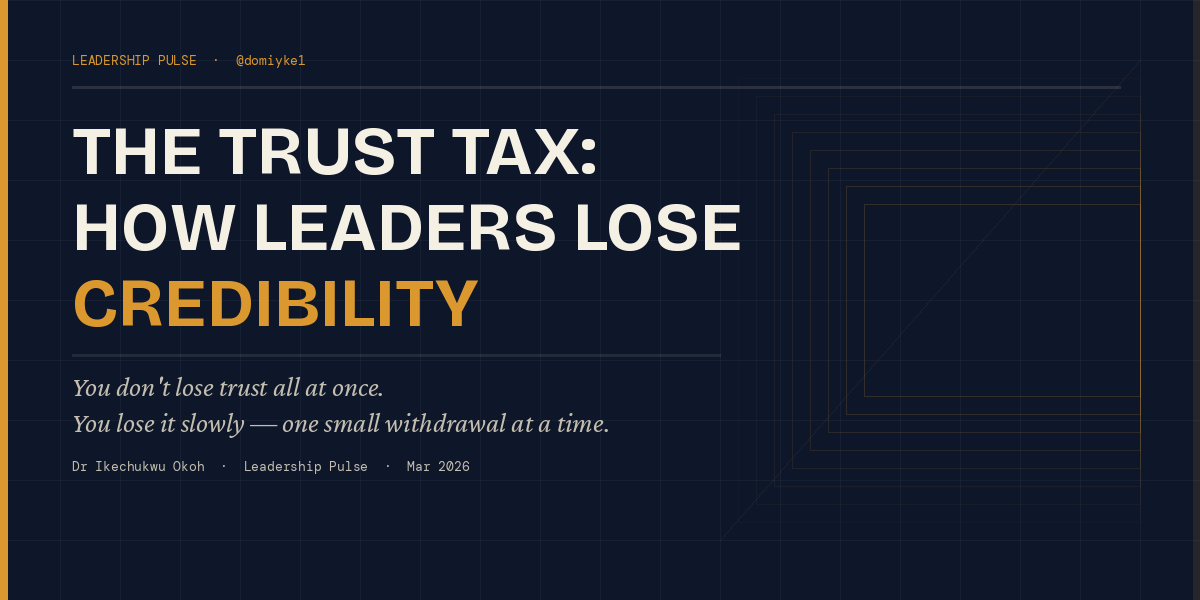
The Trust Tax:
How Leaders Lose Credibility
Without Realising It
You don't lose trust all at once.
You lose it slowly - one small withdrawal at a time.
Welcome to the Leadership Pulse
Practical insights at the crossroads of leadership, strategy, and growth. Every week, Dr Ikechukwu Okoh presents MBA-level frameworks, real-world stories, and timeless lessons to help you lead clearly, inspire purposefully, and execute effectively.
Let's develop leaders who shape the future.
Over the past two weeks, we talked about making decisions under pressure and leading honestly when you don't have all the answers.
Both of those conversations rest on a foundation that is easy to take for granted until it is gone.
Trust.
Not the grand kind. Not trust earned through a single heroic act or a perfectly delivered speech. The quiet, cumulative kind. The kind that builds invisibly over hundreds of small interactions and erodes in exactly the same way.
I want to talk about what I call the Trust Tax.
Clinical Parallel · Iatrogenic Harm
Harm caused not by the original illness, but by the treatment itself. The intervention meant to help the patient is the very thing making them worse. I have seen the leadership equivalent more times than I can count.
A leader who genuinely cares about their team. Who works harder than anyone. Who wants to do the right thing. And who, through a series of small, often unconscious behaviours, is slowly eroding the very trust they depend on.
They are not failing dramatically. No scandal. No obvious breach of confidence.
They are paying a Trust Tax - invisible withdrawals from an account they assume is still full.
Until the day they need their team to follow them somewhere difficult - and discover the account is empty.
What the Trust Tax Looks Like in Practice
The Trust Tax is rarely paid in one large transaction. It accumulates in small, repeating patterns that leaders often don't notice because they are focused on outcomes, not on the relational fabric that makes outcomes possible.
Here are the most common ones I observe - in clinical settings, executive teams, and the leaders I coach:
Saying one thing and doing another.
Not lying. Not deliberately deceiving. Simply committing to something and failing to follow through - a meeting that never happens, feedback that was promised but never given. Each instance is small. Cumulatively, the message to your team is: what you say cannot be relied upon.
Consistency only when it's convenient.
Being approachable on good days and closed off under pressure. Championing transparency in team meetings but becoming opaque when things go wrong. Your team notices the gap between the leader you are when things are easy and the leader you become when they are not.
Taking credit broadly and distributing blame narrowly.
This is the most corrosive pattern I see. A leader who allows blame to flow downward - even subtly, even without naming names - loses the loyalty of their team quietly and permanently.
Not listening to complete thoughts.
Interrupting. Finishing sentences. Asking for input and then proceeding as if none was given. Over time, your team stops sharing real information. You begin leading on a diet of curated reality.
Treating urgency as a permission slip for poor behaviour.
If your team consistently experiences you as dismissive or disrespectful under pressure, pressure becomes the thing they fear most - not because it is hard, but because of how you change when it arrives.
Why Leaders Don't Notice They're Paying It
In medicine, iatrogenic harm is particularly dangerous because the patient trusts the doctor. They assume the treatment is helping. They tolerate side effects. They don't complain.
Your team does the same thing.
They stop bringing you problems early. They start managing your moods before managing the work. They disengage from their best ideas because they have learned that input doesn't change outcomes.
You don't get fired for this. The numbers may even look fine. But you have lost the thing that separates functional leadership from exceptional leadership.
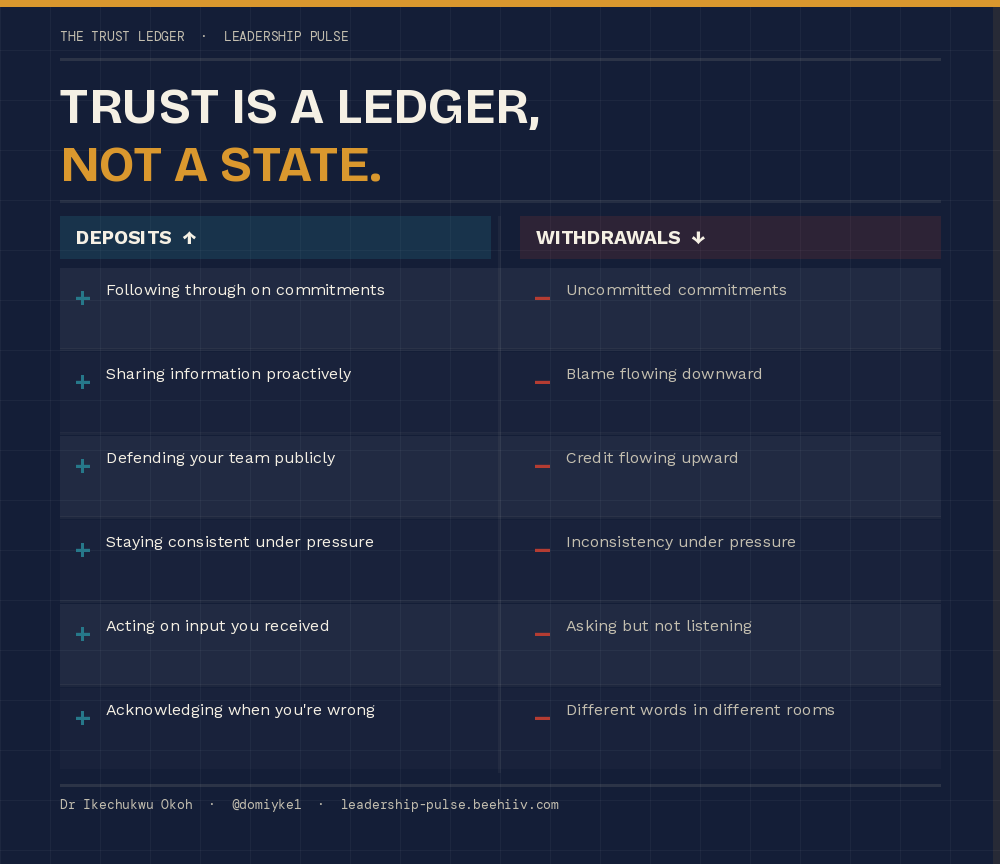
The Trust Deposit Framework
Trust is not a state. It is a ledger.
Every interaction makes a deposit or a withdrawal. Most leaders focus on the big deposits while making dozens of small withdrawals they never account for.
The goal is a consistent net positive - and the awareness to know when you are withdrawing faster than you are depositing.
| Deposits ↑ | Withdrawals ↓ |
| + Doing what you said you would do | − Uncommitted commitments |
| + Acknowledging when you were wrong - specifically | − Public values, private inconsistency |
| + Sharing information before they ask | − Blame flowing down, credit flowing up |
| + Staying consistent in character under pressure | − Changing position without explaining why |
| + Acting demonstrably on input you received | − Treating people by proximity to power |
| + Defending your team publicly | − Different words in different rooms |
The leaders who sustain trust over years are not those who never make withdrawals. They are those who are aware of the ledger, make deposits deliberately, and repair withdrawals quickly when they happen.
How to Repair Trust Once It Has Eroded
This is where most leadership advice stops. It tells you how to build trust but not how to rebuild it.
Rebuilding eroded trust requires three things - in this order:
Acknowledge specifically, not generally.
"I know I haven't always been consistent" lands differently than "I know I let you down when I didn't follow through on the team restructure conversation I promised you in January." Specific acknowledgement signals you were paying attention. General acknowledgement signals that you are performing repair rather than doing it.
Change the behaviour before you speak about it again.
The most damaging trust repair strategy is the apology followed by the same behaviour. Change first. Talk about it second. Never the other way around.
Give it time without demanding credit.
Rebuilt trust cannot be rushed, and it should not be lobbied for. Do the work. Be consistent. Let the evidence accumulate. Asking "do you trust me now?" before the evidence has compounded is another withdrawal in disguise.
This Week's Leadership Practice
The Trust Ledger Audit
Think about the three people on your team whose honest assessment of your leadership would matter most to you. For each one, answer these questions - privately and honestly:
What is one commitment I made to this person in the last 90 days that I haven't fully followed through on?
In the last month, have I given this person credit publicly for their contribution?
When did I last ask this person for their honest opinion - and genuinely act on what they said?
Would this person say that I am consistent - the same leader in difficult moments as in easy ones?
You don't need to share these answers with anyone. But if the audit reveals a pattern, you now know where the withdrawals are happening.
Start making deposits there this week. Not a grand gesture. One specific, consistent, followed-through action. That is how the ledger turns.
What I'm Reading This Week
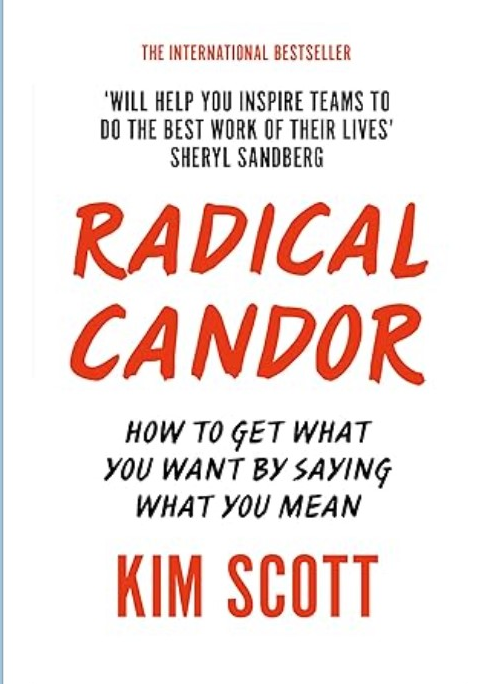
Radical Candor - Kim Scott
This week's edition is about the cost of not telling people the truth. Kim Scott spent years at Google and Apple watching leaders fail their teams not through cruelty but through what she calls ruinous empathy - being so concerned with not hurting someone that you withhold the honest feedback they need to grow. Radical Candor is the best framework I know for giving hard feedback in a way that genuinely helps people rather than protecting your own comfort.
Get it on Amazon →This contains an affiliate link. If you purchase through it, I may earn a small commission at no extra cost to you. I only recommend resources I've read and genuinely believe in.
From the Feed This Week
Every day I share a short leadership idea on LinkedIn. Here is the one that sparked the most conversation this week.
You can make the right calls but still break your team.
Read the full post and join the discussion →
Now Available
The Authority Playbook
If today's edition resonated - if you recognise that credibility is built in small, deliberate actions over time - then The Authority Playbook was written for you.
It is the complete system I use to help healthcare leaders, founders, and executives build genuine authority and consistent income from their expertise. Inside you will find the ACE Framework for establishing LinkedIn authority, the 90-Day Visibility Challenge, a step-by-step guide to designing high-value offers, and the Trust Funnel that converts followers into clients - without spending on ads.
Over 25,000 leaders have engaged with this work. Available now for £27 - instant access.
Get The Authority Playbook - £27 →
Module 01 Now Live
The Executive Edge Audio Course
The Trust Tax, the SCOPE Framework, the CLEAR Framework - the ideas in this newsletter series are drawn from two decades of leading in emergency medicine, executive coaching, and working with founders and healthcare leaders across Sub-Saharan Africa and beyond.
That body of work is now a 6-module structured audio course. 10-15 minutes per module. Audio-first. Lifetime access on Kajabi. Certificate of completion included.
Module 01 - The Diagnostician Leader - is live now. The remaining five modules follow in sequence.
247+
on the list
6
modules + cert
18
days to close
Founding Member Benefits
✓ Locked-in pricing for life
✓ Free bonus module unavailable after launch
✓ Priority invitation to live Q&A with Dr. Okoh
✓ Early access before public launch
Takes 60 seconds · No payment required now · Unsubscribe anytime
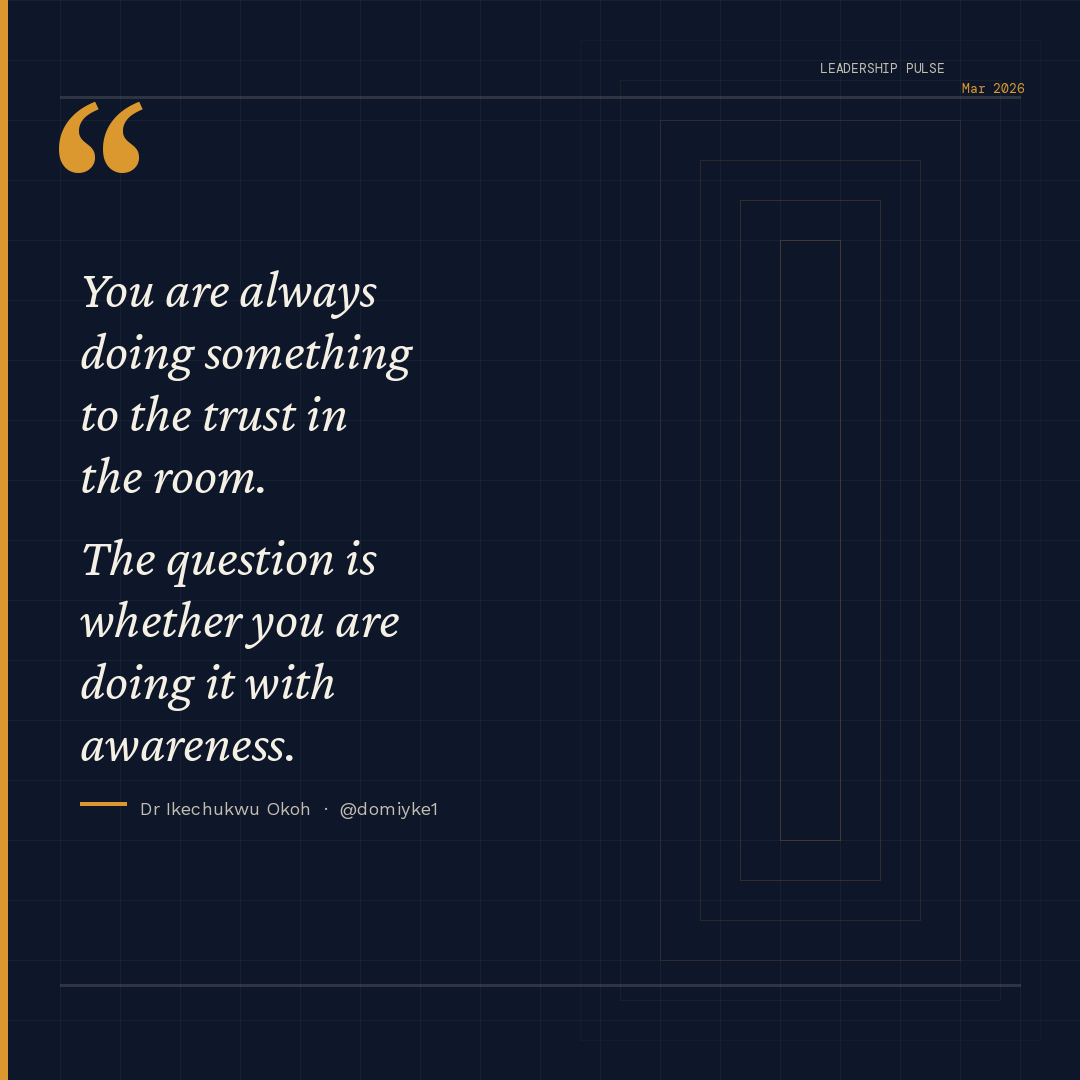
You are always doing something to the trust in the room. The question is whether you are doing it with awareness.
Final Thought
In medicine, we have a principle that sits above almost everything else.
First, do no harm.
It is a reminder that the act of treating - however well-intentioned - carries its own risks. The healer must be as aware of what they are taking away as what they are giving.
Leadership carries the same obligation.
You are always doing something to the trust in the room. Depositing or withdrawing. Building or eroding. The question is not whether you are affecting it - you are, in every interaction. The question is whether you are doing so with awareness.
First, do no harm to the trust of the people who follow you. Everything else in leadership becomes possible when that account stays full.
Lead honestly. Lead clearly. Lead with trust.
If this edition named something you have been aware of but not yet acted on - forward it to one leader in your network who needs to read it. It might be the conversation that changes their team.
And if you want to work on your own leadership credibility with structure and support - book a discovery call.
Book a Discovery Call →Dr Ikechukwu Okoh
Healthcare leader, executive coach, angel investor, and Group Head at Boulevard Group. He blends clinical experience, business strategy, and systems thinking to help leaders and organisations grow with clarity and impact.
All previous editions at leadership-pulse.beehiiv.com · See my recommendations
