
In partnership with


The Room Hears About You Before It Hears From You
She was the strongest clinician in the department, and everyone knew it.
I worked alongside her for three years.
When a case went wrong on another ward, she was the person they called.
Her audit data was among the best in the region.
Patients trusted her.
Junior doctors sought her advice.
When difficult decisions had to be made under pressure, she was often the person others looked towards.
When a deputy medical director role opened, she applied.
She was the obvious internal candidate.
Everyone assumed she would at least be shortlisted.
She was not.
I remember the afternoon she found out.
She was not angry in the way people usually imagine anger.
She was quiet.
For almost twenty minutes, she repeated variations of the same sentence.
"I don't understand."
"I am better at this job than some of the people they interviewed."
The uncomfortable truth was that she was largely correct.
Clinically.
Operationally.
In judgment.
In credibility with frontline teams.
She was ahead of many people who would later secure similar leadership roles.
But there was one thing she had never noticed.
The people making the decision did not know her.
Not directly.
Not through a regional project.
Not through a board committee.
Not through a colleague in another organisation.
Not through a sponsor who had seen her judgment, tested elsewhere.
She had built extraordinary competence inside one set of walls.
Almost nobody outside those walls had heard her name before they saw it on an application form.
One Lesson That Took Me Years to Learn
For a long time, I believed that if I did the work well enough, for long enough, the right opportunities would eventually arrive.
This is a natural belief for clinicians.
In clinical practice, competence often produces visibility.
People see your work.
Word travels through referrals, handovers, corridor conversations, and professional reputation.
What I did not understand for many years is that this kind of reputation has a radius.
It travels within the system, where people can directly observe your work.
It does not automatically travel beyond it.
Some of the most important opportunities in my own career did not come through applications.
They came through conversations.
An introduction.
A recommendation.
An invitation.
Someone mentioned my name in a room I was not in.
Someone transferred credibility before I arrived.
Someone opened a door I could not have opened myself.
That pattern repeated itself often enough that eventually I stopped treating it as a coincidence.
The lesson was simple.
Expertise gets noticed. Opportunities move through people.
The strongest professional network is not the largest.
It is the network willing to advocate for you when you are absent.
The Real Mechanism Behind Opportunity
Many professionals still believe opportunities operate like an examination system.
Study hard.
Perform well.
Receive a reward.
Sometimes that happens.
Often it does not.
Leadership opportunities are rarely distributed through perfectly objective processes.
People make decisions.
And people rely heavily on trust.
Before a promotion is approved, someone usually speaks on your behalf.
Before a founder secures investment, someone usually vouches for them.
Before a board appointment is offered, someone often recommends a name.
Before a strategic partnership emerges, somebody introduces somebody.
Influence moves through trust.
Trust moves through relationships.
Relationships create networks.
Which brings us to this week's principle:
Expertise gets noticed. Opportunities move through people.
Competence determines what you can do.
Networks determine how far your capabilities can travel.
One without the other creates limitations.
Strong competence without a network often remains invisible.
Strong networks without competence eventually collapse.
The leaders who create the greatest impact understand the importance of both.
Diagnostic Insight
Most professionals believe opportunities are awarded.
Most opportunities are introduced.
The introduction usually happens before the opportunity becomes visible.
The question is not whether those conversations are happening.
The question is whether your name is part of them.
The LENS Framework
N = Network

When people hear the word networking, many imagine conferences, business cards, LinkedIn requests, or superficial conversations.
That is not what I mean.
Network is not:
Collecting contacts
Accumulating followers
Random LinkedIn connections
Attending every event
Chasing visibility for its own sake
A network is something much more valuable.
It is trust capital.
It is relationship equity.
It is a reputation transfer.
It is credibility that travels ahead of you.
Most importantly:
It is the group of people willing to mention your name positively when you are not present.
In healthcare, it may be the senior clinician who recommends you for a leadership programme.
In organisational life, it may be the executive who introduces you to a board member.
In startups, it may be the founder who introduces you to investors.
In investing, it may be the operator's recommendation that causes others to pay attention.
The common denominator is not proximity.
It is trust.
The strongest networks are built slowly.
Through competence.
Generosity.
Integrity.
Reliability.
Consistency.
And a genuine interest in other people.
Networks are not short-term tactics.
They are long-term assets.
Like trust, they compound.
Attending Physician's Note
One of the most common diagnostic errors I see in high performers is assuming visibility naturally follows excellence.
It does not.
Excellence creates value.
Visibility requires translation.
Opportunities rarely move directly from performance to reward.
They move through people.
The clinician at the start of this edition had built extraordinary value.
What he had not built was a mechanism for that value to travel beyond the walls where it was created.
This is not a character flaw.
It is a blind spot.
And it is one of the most common blind spots among capable professionals because the people most likely to have it are often the people most committed to doing the work properly.
The focus is admirable.
On its own, it is incomplete.
Three Diagnostic Questions
1. Who would recommend me if I were not in the room?
Not who likes you.
Not who follows you.
Who would proactively mention your name because they trust your judgment enough to place their own credibility behind it?
If the honest answer is nobody, or only people inside your current organisation, that may be the diagnosis.
2. Which room am I trying to enter that nobody in my network currently occupies?
Be specific.
If you want board roles, do you know anyone already serving on a board who has seen your judgment tested?
If you want institutional investment, do you know any investors who have already been trusted and have worked with you directly?
Sometimes the missing bridge is not another qualification.
It is a relationship.
3. What opportunities am I expecting competence alone to create?
Write them down.
Then ask:
Has anyone outside my immediate environment seen evidence of this competence recently in a way they would remember and repeat?
This Week's Practice
Take ten minutes.
Draw three circles.
Circle One: Current Network
People who know your work well and would speak positively about it today.
Circle Two: Strategic Network
People connected to the rooms you want to enter, but who do not yet know your work deeply.
Circle Three: Missing Network
The rooms that influence your future where you currently know nobody at all.
Now identify:
One relationship to strengthen.
One relationship to rebuild.
One relationship to create.
You do not need to solve all three this week.
Naming them is the diagnosis.
Acting on them comes next.
HubSpot AEO

Picture this. A buyer opens ChatGPT and asks for a recommendation in your category. Your competitor's name comes up. Yours doesn't. And that buyer never makes it to your website.
That's happening right now in markets everywhere. And most teams don't know it's happening because it never shows up in their analytics.
HubSpot AEO shows you exactly where your brand stands in AI search, where competitors are getting recommended instead of you, and tells you specifically what to fix. No expertise needed.
Try it free for 28 days. Just $50 a month after.
From My Reading Desk
The Trusted Advisor
David Maister, Charles Green & Robert Galford

One Insight: People rarely buy expertise alone. They buy trusted expertise.
One Application: Before demonstrating capability, focus on building confidence, credibility, and genuine relationships.
Why It Matters This Week: Networks become valuable when trust exists. Trust creates advocates. Advocates create access.
From the Diagnostic Notes
Last week, I shared a reflection on why I went back to school for an MBA after already becoming a doctor.
The conversation that followed was fascinating.
Many people assumed the biggest return from the MBA was the qualification itself.
It was not.
The biggest return was learning to see problems differently.
Medicine taught me how to diagnose and treat patients.
The MBA taught me how to think about systems, strategy, finance, leadership, and execution.
What struck me about the responses was how many people described similar experiences in their own careers.
A course.
A mentor.
A new environment.
A different professional community.
Not because it gave them another certificate.
Because it expanded the rooms they could enter and the people they could learn from.
That is one of the most overlooked aspects of professional growth.
Most people think education changes what you know.
Often, its greatest value is changing who you know, who knows you, and which conversations you are invited into.
Knowledge creates capability.
Relationships create reach.
The strongest careers are built when both grow together.
That is as true for a clinician pursuing leadership as it is for a founder seeking investment or an executive preparing for a board role.
Inside This Week’s Diagnosis Room
This week’s premium case explores a transformation programme that appears to have a communication problem.
It does not.
A hospital department head and an experienced transformation strategist have been asked to co-lead a major organisational change initiative.
Both are competent.
Both are respected.
Both are frustrated.
Meetings are becoming defensive.
Stakeholders are taking sides.
Progress is slowing.
Using the LENS Framework, Network (N), I diagnose the underlying issue and explain why trust, legitimacy, and relationship capital often matter more than authority when leading across complex systems.
Paid subscribers receive:
Full case breakdown
Diagnostic questions
Root-cause analysis
Strategic prescription
Implementation roadmap
Executive coaching insights
Because leadership problems are rarely solved by treating symptoms.
They are solved by diagnosing causes.
Final Thought
The clinician from the start of this edition eventually secured the kind of leadership role she deserved.
It happened about eighteen months later than it should have.
And it happened only after she began doing something she had previously dismissed as a distraction from the real work.
She started saying yes to opportunities beyond her department.
Regional working groups.
Cross-organisational projects.
Leadership forums.
Conversations with people outside her immediate environment.
None of those activities felt like the real work.
But they became the bridge between the value she had already built and the rooms that needed to hear about it.
Her competence had never been the problem.
What was needed was a network willing to carry her name into rooms she had not yet entered.
The room hears about you before it hears from you.
The only question is whether you have given it anything worth saying.
Lead honestly. Lead clearly. Lead beyond the room you are standing in.
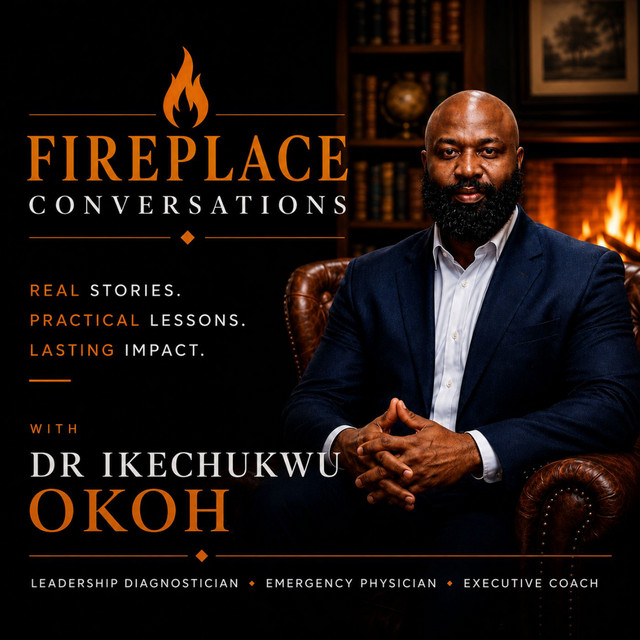
🎙 Fireplace Conversations
The latest episode explores a theme closely connected to today's edition: trust, credibility, and the influence we lose without realising it.
If today's discussion on Network resonated with you, I think you'll enjoy this conversation.
Dr Ikechukwu Okoh
Leadership Diagnostician . Emergency Physician · Executive Coach
Helping leaders diagnose and solve the problems that stall people, teams, organisations, and businesses.
Explore more at ikonmd.org
The Leadership Pulse - Founding Member Access
Real leadership cases. Clinically diagnosed. Every week.
Become a Founding MemberUnlock Exclusive Access to:
- The Diagnosis Room - a real case, fully diagnosed, every Monday
- The Clinical File - one deep case study per month
- Executive Edge early access - frameworks before they go public
- Quarterly Leadership Audit - know exactly where you stand
- Founding member pricing - locked for life
