
Sponsored by

Your Billing System Wasn't Built for This

SaaS pricing has changed. Your billing stack probably hasn't. As usage-based and hybrid models become the default, finance teams are left stitching together spreadsheets, reconciling data manually, and closing books under pressure. The cost? Revenue leakage, audit risk, and forecasts no one trusts.
Our new Buyer's Guide for Modern SaaS Billing breaks down exactly what to demand from a revenue platform built for today's complexity — from automated usage billing to AI-native collections and rev rec. Whether you're evaluating vendors or rethinking your stack, this is your framework for getting it right.
| Leadership Pulse | 20 Apr 2026 |
Founding Members Only
The Diagnosis Room - Edition 004
This week: a senior partner who discovered two team members have been presenting his strategic frameworks to clients as their own. He is certain of what happened. He does not know what to do - especially since one of the two is being considered for promotion.
Start Free 14-Day Trial →No credit card required · Already a member? Log in →
The Operating Leader · Week 3 of 4
The Meeting
Disease
How leaders waste the most expensive resource they have.
Welcome to the Leadership Pulse
Practical insights at the crossroads of leadership, strategy, and growth. Every week, Dr Ikechukwu Okoh presents MBA-level frameworks, real-world stories, and timeless lessons to help you lead clearly, inspire purposefully, and execute effectively.
We are three weeks into this series. We have diagnosed the delegation deficit and the accountability gap. Both of those problems have a common fuel source that I have been building toward.
Meetings.
Not the concept of meeting - the act of bringing people together around a shared purpose is one of the most powerful tools in leadership. The problem is what most meetings have become: a default response to complexity, a performance of collaboration, and the primary mechanism by which an organisation's most expensive resource is consumed without anyone calculating the cost.
That resource is attention. And in the organisations I work with, it is being haemorrhaged through meetings that should never have been called.
Clinical Parallel - Opportunity Cost of Attention
Every time a senior clinician is drawn into a non-clinical conversation, their attention is elsewhere. The cost is not the time lost. It is the decision not made, the patient not assessed, the early warning not caught. In organisations, meetings are the primary mechanism by which this cost is paid - invisibly, across every attendee, without appearing on any budget line.
Every meeting you call is time you are billing to someone else. The question is whether the invoice is justified.
The Five Meeting Types That Should Not Exist
Before I give you a framework for running better meetings, I want to name the meetings that should not be running at all. Most organisations have at least three of these five in their regular calendar.
| 01 | The status update meeting. No decisions made. Everyone reporting on what they have done. Every piece of information could have been a two-paragraph written update. The status update meeting exists to perform accountability, not to produce it. |
| 02 | The comfort meeting. Called not because a decision needs to be made but because the caller is anxious and meetings feel like action. The problem needs thinking time, not group time. Calling a meeting around an unformed problem does not accelerate resolution. It distributes the anxiety. |
| 03 | The information-sharing meeting. An update that requires no discussion, no decision, no input. Could be an email. Is instead forty-five minutes with twelve attendees. People can read faster than anyone speaks. Send the document. |
| 04 | The recurring meeting nobody has audited. Put in the calendar six months ago for a reason that no longer exists. Nobody cancels it because nobody wants to be the one to say the emperor has no agenda. So it runs every week. |
| 05 | The pre-meeting meeting. A symptom of unclear authority - people are not confident enough in their mandate to walk into the real meeting and decide, so they pre-negotiate in a smaller room first. Fix the authority problem. Cancel the pre-meeting. |
The PULSE Framework
For every meeting that survives the audit above, apply the PULSE framework. Five questions. Each one earns the meeting its place or removes it.
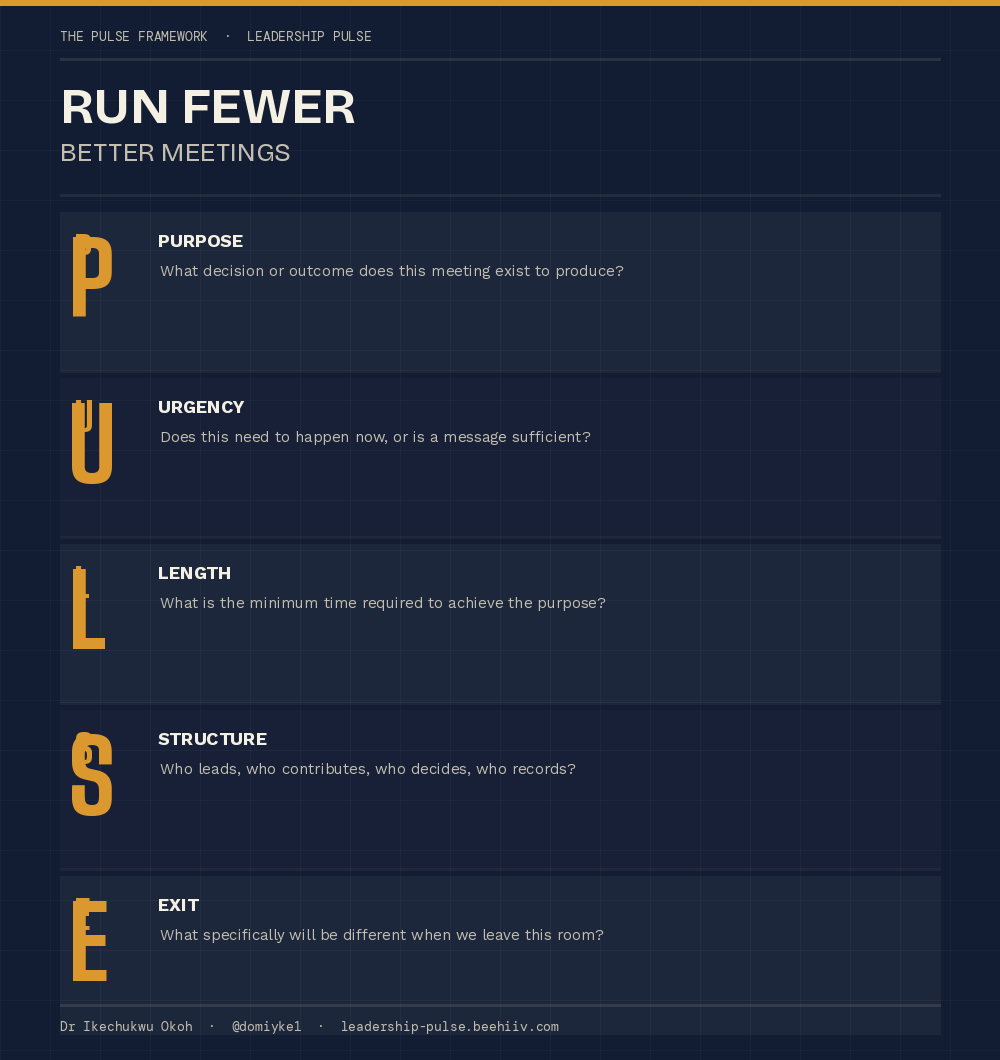
| P | Purpose: what decision or outcome does this meeting exist to produce? If you cannot answer this in one sentence, the meeting is not ready to happen. Not "to discuss the Q3 strategy" - that is a topic, not a purpose. The purpose is "to decide which of the two Q3 options we are committing to, and name who owns execution." One sentence. Specific. If it does not exist, neither should the meeting. |
| U | Urgency: does this need to happen now, or is a message sufficient? Most things that get meetings could be resolved asynchronously. Before you book the room, ask: could this be done without loss of quality in a voice note or email chain? Reserve synchronous time for what genuinely requires it - live debate, emotional complexity, decisions that need real-time negotiation. |
| L | Length: what is the minimum time required to achieve the purpose? The meeting will expand to fill the time allocated. Thirty and sixty minute defaults exist because that is what the calendar software offers, not because those are the right lengths. Book the minimum. Start on time. End when the purpose is achieved. |
| S | Structure: who leads, who contributes, who decides, who records? A meeting without a named decision-maker is a discussion, not a meeting. These four roles must be assigned before the meeting begins. When they are not, you get the most expensive pattern in organisational life - a room full of senior people talking in circles because nobody knows who has the authority to end the conversation. |
| E | Exit: what specifically will be different when we leave this room? The exit question is asked at the start of the meeting, not the end. It sets the standard against which the meeting will be measured. If nobody can answer it at the start, stop the meeting and redesign it. If nobody can answer it at the end, the meeting failed regardless of how engaged the discussion felt. |
This Week's Leadership Practice
The Meeting Audit
Open your calendar for next week. For every recurring meeting, answer three questions:
| 01 | What decision or outcome does this meeting produce? |
| 02 | If this meeting did not happen next week, what specifically would be different? |
| 03 | Could the same outcome be achieved in half the time or asynchronously? |
Cancel one meeting this week that fails the audit. See what happens. The answer will tell you everything about whether it was necessary.
What I'm Reading This Week
Death by Meeting - Patrick Lencioni
Lencioni argues that meetings are not inherently painful - they are painful because leaders treat all meeting types the same way. His framework for separating daily check-ins, weekly tacticals, monthly strategics, and quarterly reviews is the practical complement to the PULSE framework. If meetings in your organisation feel like a disease, this book is the first intervention.
Get it on Amazon →From the Feed This Week
Every day I share a short leadership idea on LinkedIn. Here is the one that sparked the most conversation this week.
Everyone is chasing the next opportunity.
Read the full post and join the discussion →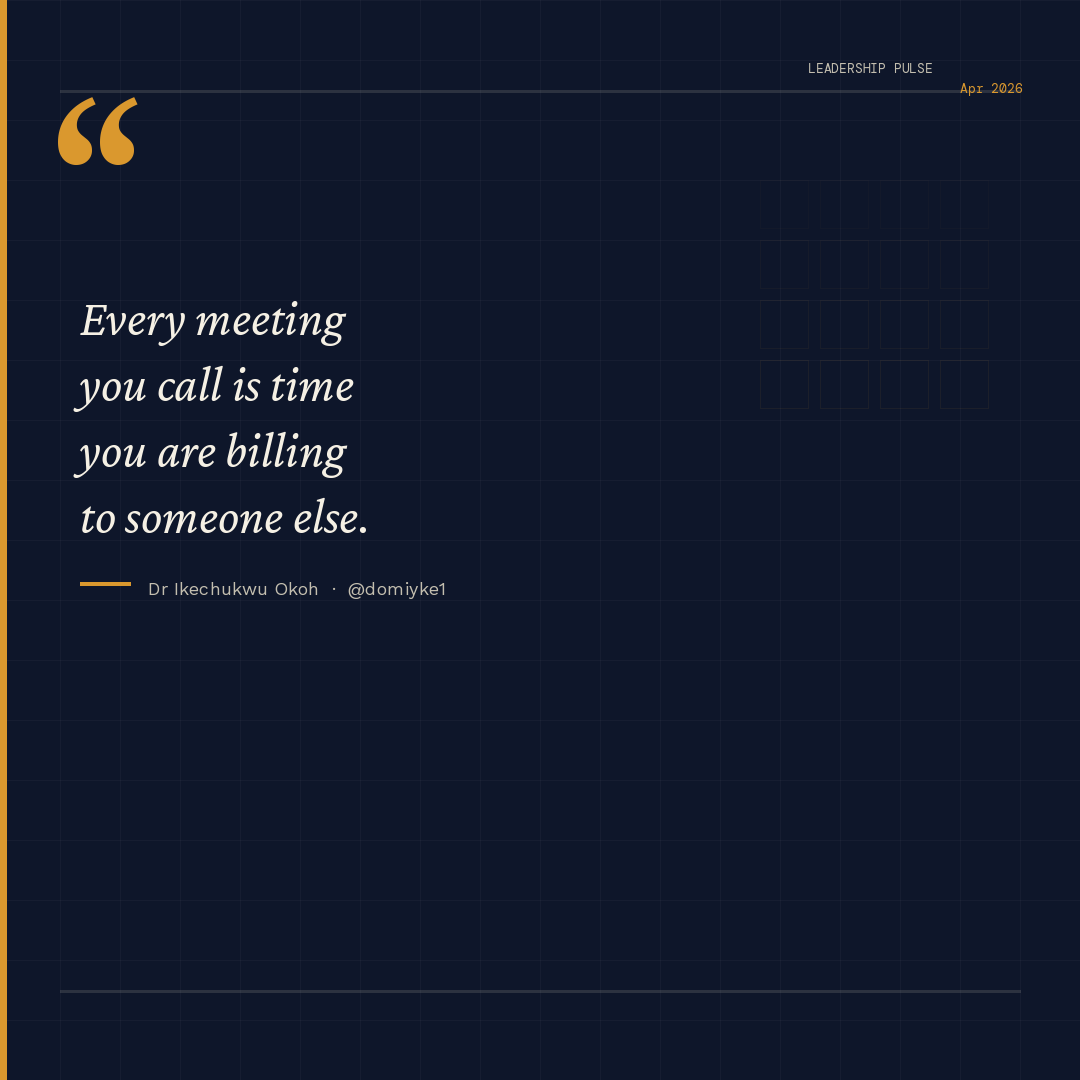
Final Thought
There is a diagnostic question I ask every leader I coach when I want to understand what they actually believe about their work.
Show me your calendar.
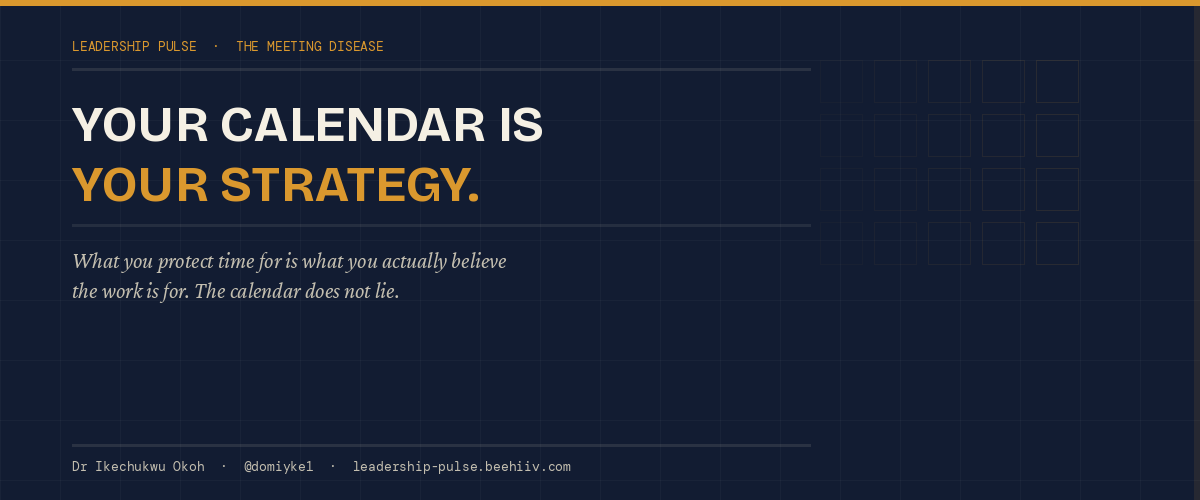
Not your strategy document. Not your vision statement. Your calendar. Because your calendar is your actual strategy. It is the revealed preference of your leadership - what you have decided is worth the time of the people you lead, expressed in hours and recurring invitations.
If your calendar is full of meetings that fail the PULSE test, your revealed strategy is the organisational performance of activity. If it is full of meetings that pass - purposeful, urgent, right-sized, structured, and exit-defined - your revealed strategy is the production of outcomes.
Lead honestly. Lead clearly. Lead with intention.
Now Available
The Authority Playbook - £27
The complete system for building genuine authority and consistent income from your expertise. Instant access.
Get The Authority Playbook →If this named a meeting in your calendar that has no business being there - cancel it this week. Then forward this to the one person in your organisation whose calendar needs this most.
Book a Discovery Call →Dr Ikechukwu Okoh
The ER keeps me honest. The boardroom gives me leverage.
| Podcast | X @domiyke1 | CV & Links |
All previous editions at leadership-pulse.beehiiv.com

The Leadership Pulse - Founding Member Access
Real leadership cases. Clinically diagnosed. Every week.
Become a Founding MemberUnlock Exclusive Access to:
- The Diagnosis Room - a real case, fully diagnosed, every Monday
- The Clinical File - one deep case study per month
- Executive Edge early access - frameworks before they go public
- Quarterly Leadership Audit - know exactly where you stand
- Founding member pricing - locked for life
