
In partnership with

Turn AI into Your Income Engine

Ready to transform artificial intelligence from a buzzword into your personal revenue generator?
HubSpot’s groundbreaking guide "200+ AI-Powered Income Ideas" is your gateway to financial innovation in the digital age.
Inside you'll discover:
A curated collection of 200+ profitable opportunities spanning content creation, e-commerce, gaming, and emerging digital markets—each vetted for real-world potential
Step-by-step implementation guides designed for beginners, making AI accessible regardless of your technical background
Cutting-edge strategies aligned with current market trends, ensuring your ventures stay ahead of the curve
Download your guide today and unlock a future where artificial intelligence powers your success. Your next income stream is waiting.

The Operating Leader · Week 1 of 4
The Delegation
Deficit
Why leaders hold on to work that is killing them.
Welcome to the Leadership Pulse
Practical insights at the crossroads of leadership, strategy, and growth. Every week, Dr Ikechukwu Okoh presents MBA-level frameworks, real-world stories, and timeless lessons to help you lead clearly, inspire purposefully, and execute effectively.
Let's develop leaders who shape the future.
There is a clinical presentation I want to describe.
A patient arrives complaining of fatigue, poor sleep, a persistent feeling of being overwhelmed. They cannot switch off. Their work follows them everywhere. They are first in and last out. They feel irreplaceable - and deeply, quietly resentful of it.
I have seen this presentation dozens of times. Not always in a hospital.
The diagnosis is not burnout. Not yet. The diagnosis is delegation deficit - a chronic condition in which a leader is performing work that belongs to someone else, and cannot find a way to put it down.
Clinical Parallel · Capacity Deficit
In medicine, a deficit is measured precisely. A haemoglobin deficit of a certain level produces predictable symptoms. The body is honest about what it is missing. Leadership organisations are far less honest. The cost of a delegation deficit is real - but it distributes itself in ways that are easy to misattribute.
The work that is killing you is work you chose to keep.
Why Leaders Hold On
Ask most leaders why they do not delegate more and they will tell you one of three things. Nobody else can do it to the required standard. It is faster to do it themselves. They have tried before and it did not work.
All three are symptoms. None of them is the cause.
The real reasons fall into four patterns. I call it the HOLD diagnostic - not a framework for fixing the problem, but a framework for seeing it clearly first.

Habit.
The task was theirs when the organisation was smaller, when they were more junior, when there was nobody else. The organisation grew. The role changed. The task stayed. Nobody made a deliberate decision to keep it. It simply never got questioned.
Ownership anxiety.
Delegation feels like loss of control. If someone else does the work, the leader loses visibility into it. The task stays because the leader does not trust the system around them enough to let go of it.
Learned helplessness in others.
The leader has trained their team - inadvertently - not to take ownership. Every time they stepped back in and took a task back, every time they corrected without coaching, they created a team that waits to be told. Now they look around and see nobody capable. They are not wrong. They built that.
Discomfort with strategic space.
This is the pattern most leaders will not name. When a leader delegates successfully, they create space. For leaders who have been operationally busy for years, that space is uncomfortable. Strategic thinking, relationship building, long-range planning - these do not feel like work. They feel like idleness. So the leader fills the space back up. With tasks that are not theirs.
What the Deficit Costs
The leader who is doing work that belongs to someone else is not doing the work that belongs to them. Strategy. Culture. Relationships. Long-range thinking. The work that only the leader can do goes undone - not because the leader is lazy, but because every hour has been filled with work that could have been done by someone else.
The team that is not being delegated to is not developing. The organisation builds a ceiling at the level of what one person can personally execute.
This is not a growth problem. It is a delegation problem wearing a growth problem's clothes.
The organisation builds a ceiling at the level of what one person can personally execute.
The GRIP Framework
The HOLD diagnostic tells you why you are holding on. The GRIP framework tells you how to let go without losing control.
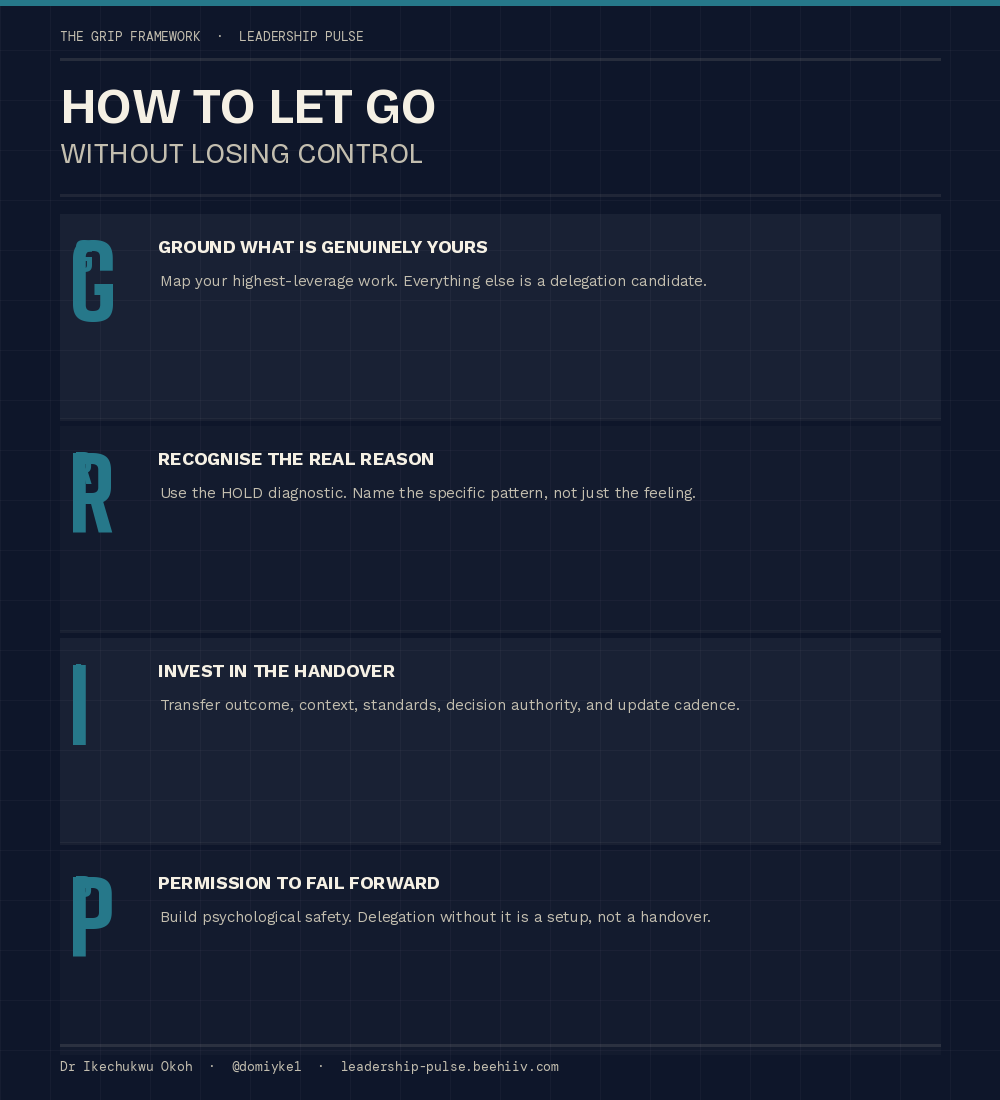
Ground what is genuinely yours.
Ask: what decisions require my specific judgment, relationships, or authority? What work produces outcomes that only I am positioned to produce? Everything outside that category is a candidate for delegation. Most leaders find the list of work that is genuinely theirs is much shorter than they expected.
Recognise the real reason you are holding.
Use the HOLD diagnostic. Which of the four patterns is driving you? Be specific. Not "I find it hard to let go" - that is a description, not a diagnosis. The reason matters because the solution is different for each one.
Invest in the handover.
The most common reason delegation fails is that the leader hands over a task, not a brief. A proper handover has five components: the outcome, why it matters, what good looks like, the decision authority the person has, and when and how you want to be updated. Most leaders do one or two. The missing ones are always the reason delegation does not hold.
Permission to fail forward.
Delegation without psychological safety is not delegation - it is a setup. If your team member knows that mistakes will be corrected publicly, that their authority will be overridden without explanation, or that you will take the work back at the first sign of difficulty, they will not take real ownership. Create explicit permission to make mistakes and learn from them. This is not lowering standards. It is building the conditions under which standards can eventually be met without you.
This Week's Leadership Practice
The Delegation Audit
Write down every task you completed in the last two weeks. Every meeting. Every decision. Every document reviewed or produced. Against each one, ask a single question:
Is this genuinely mine?
Not "am I the best person to do this." Not "could someone else match my standard." Just: does this belong at my level, or am I doing it for one of the four HOLD reasons?
Then take the single task you know you should not own and brief it to someone this week. Use all five components of the GRIP handover. Do not take it back for four weeks. What you learn from watching someone else hold the work is where the real development happens.
What I'm Reading This Week
The ONE Thing - Gary Keller & Jay Papasan
The central question of this book is deceptively simple: what is the one thing I can do right now that will make everything else easier or unnecessary? If the delegation audit reveals you are doing fifty things, this book will help you identify the two or three that are genuinely yours. The rest is a delegation list.
Get it on Amazon →This contains an affiliate link. I may earn a small commission if you purchase through it.
From the Feed This Week
Every day I share a short leadership idea on LinkedIn. Here is the one that sparked the most conversation this week.
The way you give feedback is making things worse
The way you give feedback is making things worse. Not because you do not care. Because no one taught you how. Most feedback conversations follow the same broken script: Compliment ➡️ Criticism ➡️ Compliment. The feedback sandwich. Everyone knows it is coming. Nobody believes the bread. The person walks away remembering only the criticism. And mistrusting the praise on either side of it. What actually works:....
Read the full post and join the discussion →The Diagnosis Room
Real leadership cases. Clinically diagnosed. Every week.
This week's case goes directly to the heart of the delegation deficit. A founder in Abuja with eight talented people who will not move without his permission. He built this team - one behaviour at a time over eighteen months. The full clinical breakdown shows exactly which four behaviours created it, and a step-by-step prescription for reversing it.
This week's Diagnosis Room is also available as a downloadable PDF case file - four pages, formatted for printing, annotating, and returning to when the same pattern shows up again.
Diagnosis Room weekly
PDF case file every edition
Clinical File monthly
Quarterly Leadership Audit
£8/month · or £75/year · 14-day free trial · No credit card required · Cancel anytime
Already a founding member? Log in to read this week's case and download the PDF →
Now Available
The Authority Playbook
The complete system for building genuine authority and consistent income from your expertise. ACE Framework, 90-Day Visibility Challenge, high-value offer design, Trust Funnel. Available now for £27 - instant access.
Get The Authority Playbook - £27 →Module 01 Now Live
The Executive Edge Audio Course
6 modules. Audio-first. Lifetime access on Kajabi. Certificate of completion. Module 01 live now. 247+ on the waitlist.
Reserve My Founding Member Spot →
Final Thought
In the emergency department, we have a principle that governs how we allocate clinical resource during a major incident.
The most skilled clinician does not treat the most patients. They direct the most clinicians.
The value of the most experienced person in the room is not in their hands. It is in their judgment. Their role is to ensure that the right person is doing the right thing at the right time - not to do every right thing themselves.
The work that is killing you is work you chose to keep. You can choose differently.
Lead honestly. Lead clearly. Lead with leverage.
If this edition named something you have been aware of but not yet acted on - forward it to one leader in your network who needs to read it. The delegation audit takes 30 minutes. The return compounds for years.
Book a Discovery Call →Dr Ikechukwu Okoh
Healthcare leader, executive coach, angel investor, and Group Head at Boulevard Group. He blends clinical experience, business strategy, and systems thinking to help leaders and organisations grow with clarity and impact.
All previous editions at leadership-pulse.beehiiv.com · See my recommendations
The Founder Who Built a Team That Waits

The Leadership Pulse - Founding Member Access
Real leadership cases. Clinically diagnosed. Every week.
Become a Founding MemberUnlock Exclusive Access to:
- The Diagnosis Room - a real case, fully diagnosed, every Monday
- The Clinical File - one deep case study per month
- Executive Edge early access - frameworks before they go public
- Quarterly Leadership Audit - know exactly where you stand
- Founding member pricing - locked for life
