
| Leadership Pulse | 4 May 2026 |
Founding Members Only
The Diagnosis Room - Edition 006
This week: a board member privately briefed by two direct reports that the CEO she appointed is not performing. She cannot unknow it. She does not know what to do with it. The full clinical breakdown is inside.
Start Free 14-Day Trial →No credit card required · Already a member? Log in →
The Influence Architecture · Week 1 of 4
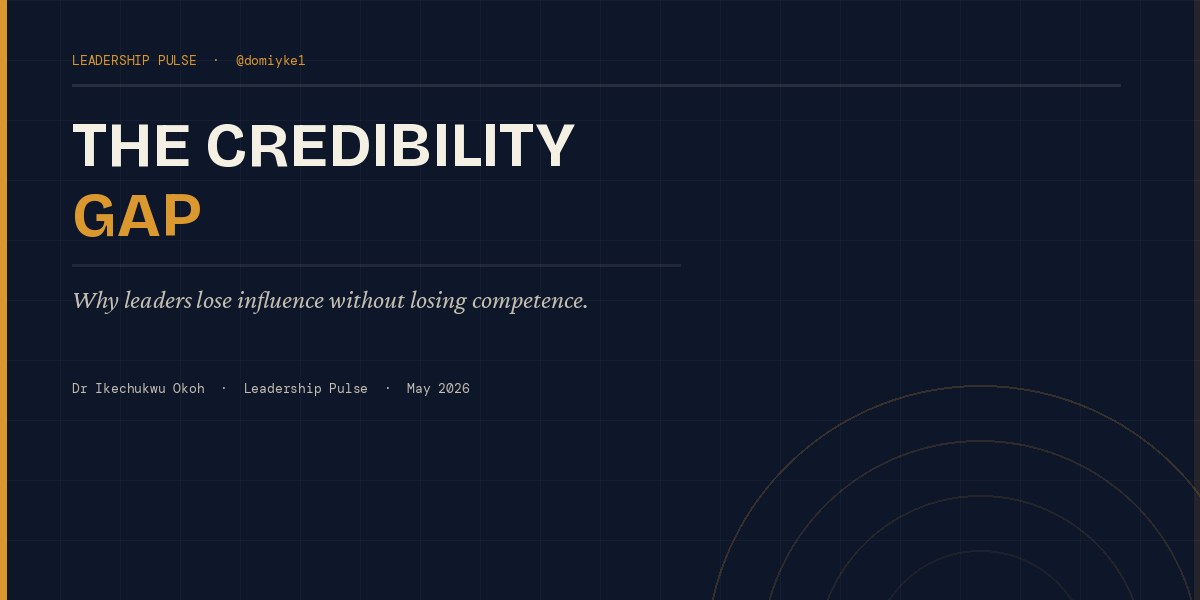
The Credibility
Gap
Why leaders lose influence without losing competence.
Welcome to the Leadership Pulse
Practical insights at the crossroads of leadership, strategy, and growth. Every week, Dr Ikechukwu Okoh presents MBA-level frameworks, real-world stories, and timeless lessons to help you lead clearly, inspire purposefully, and execute effectively.
On the morning of 28 January 1986, the Space Shuttle Challenger lifted off from Cape Canaveral and broke apart 73 seconds later. Seven crew members died.
The engineering failure - O-rings that could not seal in cold temperatures - had been flagged the night before by the engineers at Morton Thiokol. They had the data. They had the analysis. They had the correct answer. They spent hours arguing for a launch delay.
The launch proceeded anyway.
What failed was not the engineering. It was the influence. The people who understood the risk did not have enough credibility in that room, on that night, under that pressure, to change the decision of the people who held the authority.
This is the defining pattern of the credibility gap. Competence that cannot convert into influence. Knowledge that cannot move decisions. Being right in a way that changes nothing.
Credibility is not what you claim about yourself. It is what others can prove about you.
Opening the Series
Over the last four weeks we diagnosed the operating problems that drain a leader's effectiveness - delegation, accountability, meetings, energy. This new four-week series goes deeper. We are not talking about what you do. We are talking about whether people believe you enough to follow you when it matters. Influence is the operating system. Credibility is the power source. We start there.
What the Credibility Gap Actually Is
The credibility gap is the distance between how much authority a leader holds and how much influence they actually have. You can have the title, the mandate, and the formal power - and still find that people nod in meetings and do something different afterwards. That gap is the diagnosis.
It appears in four specific patterns. Each one is common enough that most leaders have experienced at least two of them without naming what was happening.
| 01 | The visible advocate who is a private exception. They champion accountability in team meetings and quietly avoid difficult conversations in private. They promote transparency in their communications and manage information selectively when it suits them. The team notices the gap between the public position and the private behaviour. That gap is the credibility gap. It accumulates silently and surfaces at the worst possible moment. |
| 02 | The leader whose commitments are provisional. They say they will do something and then do not. Not dramatically - not in ways that get raised explicitly. But the pattern accumulates. The team builds a mental model of what this leader's word is worth. That mental model is the credibility account, and it is either in credit or in deficit. Most leaders have no idea which. |
| 03 | The expert who is not believed. Genuine technical expertise that never converts into influence because it was never built on a foundation of behavioural credibility. The team respects their knowledge. They do not trust their judgment. These are different things. Knowledge is what you know. Judgment is what you do with what you know under pressure. The second is what builds credibility. |
| 04 | The leader who performs credibility rather than building it. Impressive communication. Strong presence in senior meetings. A personal brand that reads well. None of this is credibility. It is the appearance of credibility, which is useful in the short term and destructive in the long term. The moment the performance meets a test it cannot pass, everything built on it collapses faster than it was assembled. |
The CORE Framework
Credibility is built from four elements. Not claimed. Not performed. Built - through repeated behaviour over time, visible to the people you are trying to influence.
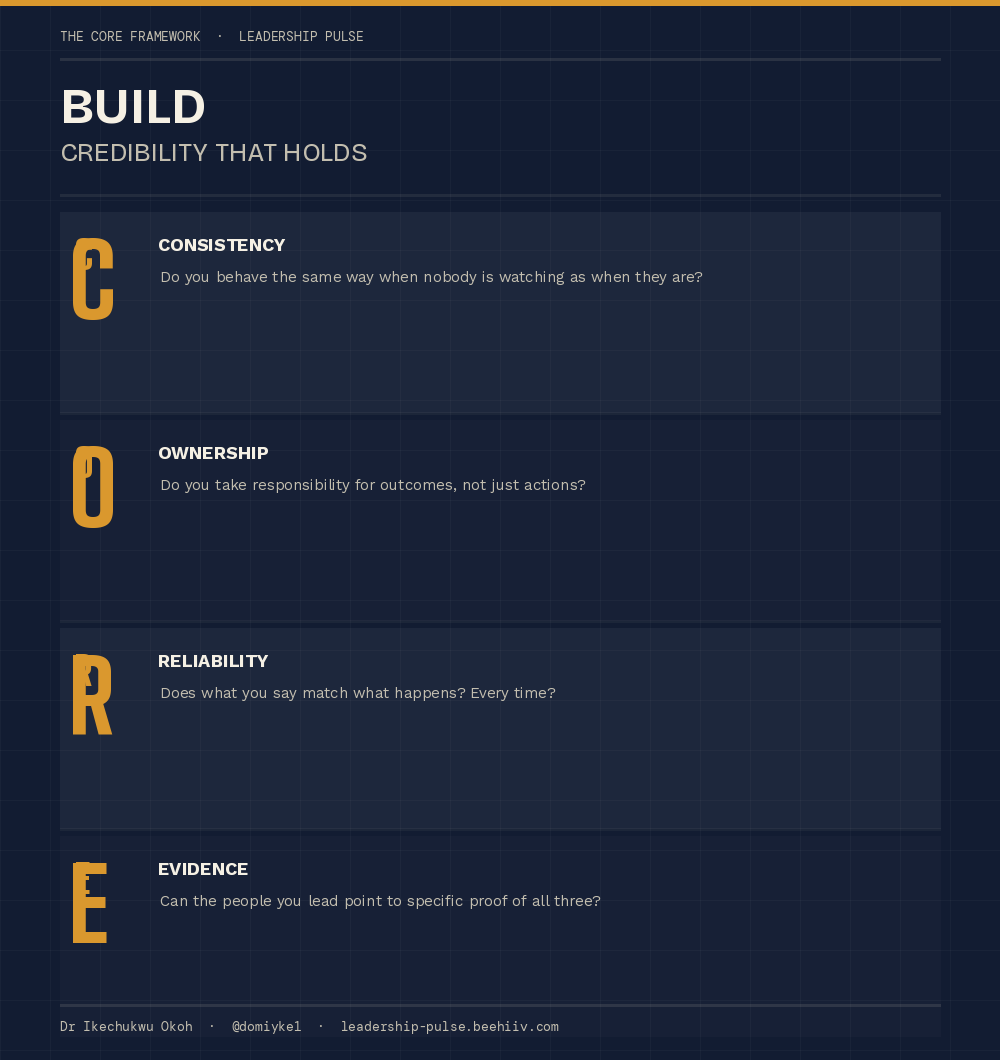
| C |
Consistency. Consistency is not about being predictable in a rigid way. It is about behavioural alignment - doing the same thing whether or not you are being observed, whether the stakes are high or low, whether you feel like it or not. The test of consistency is not what you do in the visible moments. It is what you do in the invisible ones. Your team is watching both. The gap between them is exactly what they are measuring. |
| O |
Ownership. Ownership means taking responsibility for outcomes, not just for actions. "I followed the process" is accountability to procedure. "The result is mine" is accountability to outcome. These feel similar but produce entirely different responses in the people watching. A leader who owns a bad result - clearly, without qualification, without distributing the responsibility across the team - builds credibility faster than almost any other single behaviour. It is rare enough to be remarkable. |
| R |
Reliability. Reliability is about the match between what you say and what happens. Every commitment kept is a deposit into the credibility account. Every commitment missed is a withdrawal - with interest, because it retroactively reduces the value of future commitments. Reliability is not about being perfect. Nobody is. It is about the ratio, and about what you do when you miss. A leader who misses a commitment and acknowledges it directly and promptly loses less credibility than one who misses and says nothing. |
| E |
Evidence. The final element is the most diagnostic. Can the people you lead point to specific, concrete instances of your consistency, ownership, and reliability under pressure? Not general character assessments - not "she is trustworthy" or "he means well." Specific evidence. Named situations. Recalled behaviours. If your team cannot produce that evidence quickly, credibility has been talked about but not built. Evidence is the proof of work. Without it, the other three elements are claims. |
This Week's Leadership Practice
The Credibility Audit
Ask one person you trust - a peer, a direct report, a mentor - one question:
"What is one situation where my behaviour surprised you - positively or negatively?"
The positive surprises tell you where your credibility is strongest. The negative ones tell you where the gap is. Both are data. Most leaders have never asked this question directly. The answer, when it comes, is the most accurate credibility diagnostic available - more accurate than any self-assessment.
Do not defend the negative answer. Write it down. Sit with it. That is where the work is.
What I'm Reading This Week
The Speed of Trust - Stephen M.R. Covey
Covey makes the economic case for credibility - trust as a business variable that accelerates or taxes every transaction, decision, and relationship in an organisation. His framework for the behaviours that build and destroy trust is the most systematic treatment I know of what this edition is covering. The CORE framework distils the clinical version of the same argument. If you want the full case, this is the book.
Get it on Amazon →From the Feed This Week
Every day I share a short leadership idea on LinkedIn. Here is the one that sparked the most conversation this week.
Your team is not underperforming. Your expectations are unclear.
Read the full post and join the discussion →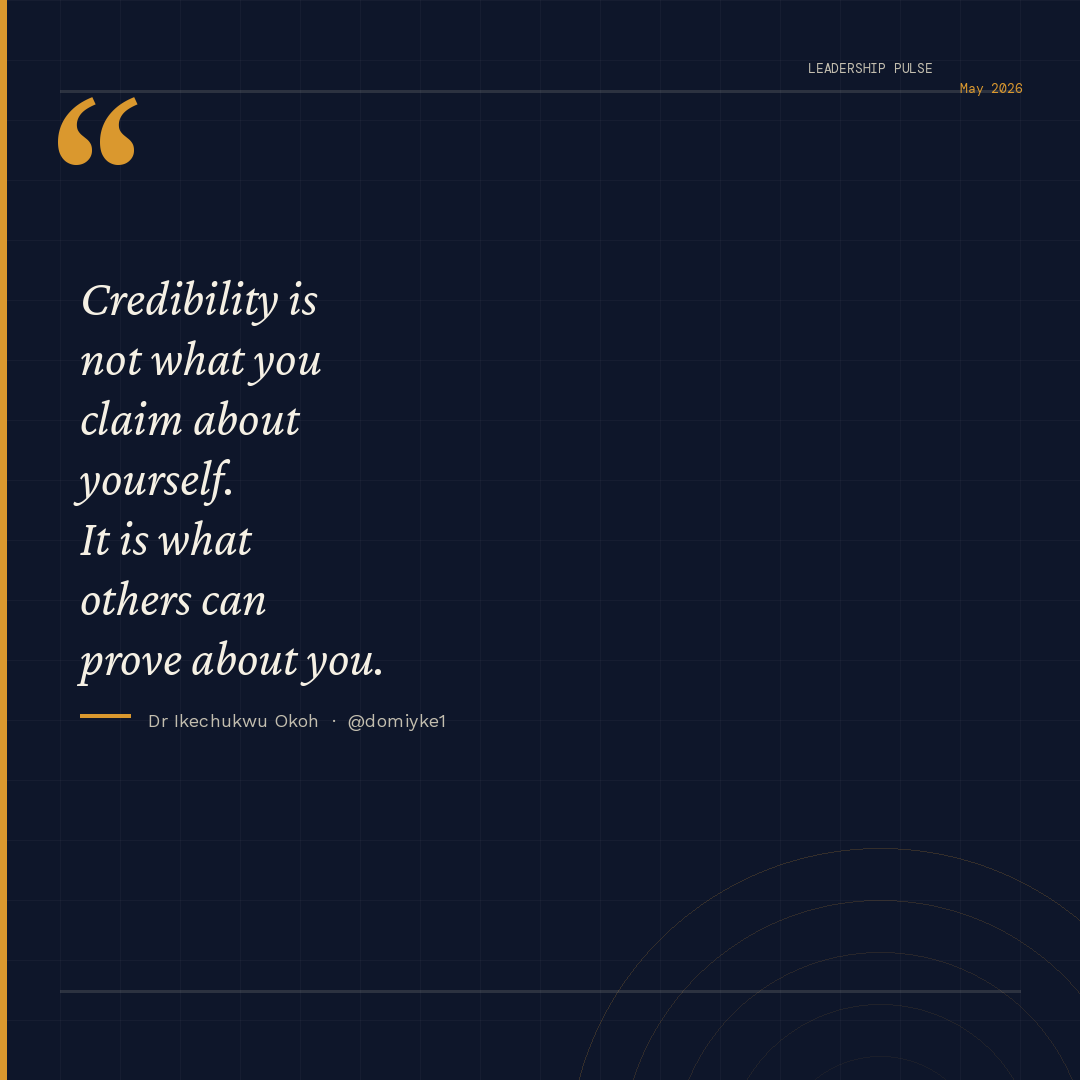
Final Thought
The engineers at Morton Thiokol were right about the O-rings. They had the data, the analysis, and the correct answer. They could not change the decision because the credibility required to move it was not available to them in that room on that night.
Credibility is not built in the moment you need it. It is built in every moment before that - in the consistency of your behaviour when the stakes are low, in the ownership you take when the result is bad, in the commitments you keep when keeping them is inconvenient, in the evidence your team accumulates about who you are under pressure.
You cannot borrow credibility, perform it, or demand it. You can only build it - one kept commitment, one owned result, one consistent decision at a time.
Lead honestly. Lead clearly. Lead with credibility.
|
Now Available The Authority Playbook £27 - instant access Get access → |
Module 01 Live Executive Edge Course 247+ on the waitlist Join waitlist → |
Forward this to one leader whose influence is not matching their competence. Sometimes naming the gap is the first intervention.
Book a Discovery Call →Dr Ikechukwu Okoh
The ER keeps me honest. The boardroom gives me leverage.
| Podcast | X @domiyke1 | CV & Links |
All previous editions at leadership-pulse.beehiiv.com
The Leadership Pulse - Founding Member Access
Real leadership cases. Clinically diagnosed. Every week.
Become a Founding MemberUnlock Exclusive Access to:
- The Diagnosis Room - a real case, fully diagnosed, every Monday
- The Clinical File - one deep case study per month
- Executive Edge early access - frameworks before they go public
- Quarterly Leadership Audit - know exactly where you stand
- Founding member pricing - locked for life
